☕ DrinkCoffeeAndProfit
Smart money moves before breakfast
· · · Partner Message · · ·
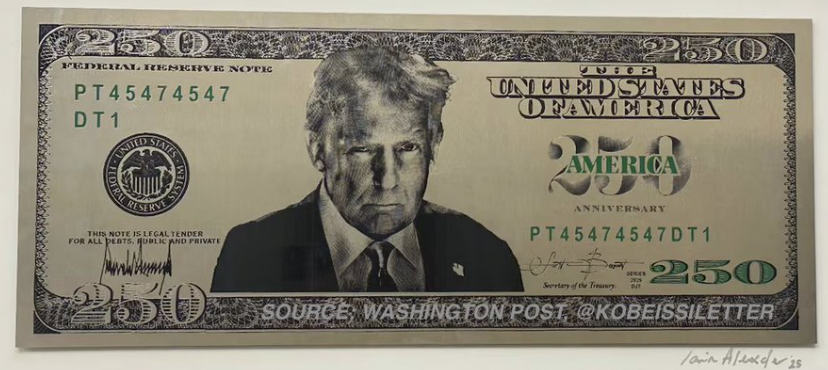
President Trump is launching a new $250 bill with his face on it – the first living president to do so since Abraham Lincoln’s $10 demand note in 1861.
Trump $250 Bill
Source: The Kobeissi Letter, X.
Earlier this year, he instituted another currency change – insisting that his signature appear on all new bank notes.
If you’re starting to sense that Trump has taken an unusual interest in our money, you’re on the right track.
In fact, I’d like to show you that his new $250 bill is a mere distraction from a far bigger and more consequential change to U.S. currency being orchestrated behind the scenes.
Something that will affect every dollar you’ve ever saved or invested.
Bypassing all conventional legal and political channels, under the guise of national security, Trump is enacting a total money reset using a landmark executive order (14241).
Democrat or Republican, support him or despise him, it doesn’t matter – the wheels are already in motion.
And that means every American may soon be forced to use Trump’s New Dollar to fill your gas tank, buy groceries, pay the bills.
Which is why I’ve produced this critical new documentary laying out exactly what this means for your savings, your investments, and your family’s financial future…
Detailing three important steps you can take today to prepare – including details on a core band of assets connected to Trump’s initiative that could surge, if this plays out as I predict…
Plus the name and ticker of my #1 move to make today.
As you’ll see in my briefing, the last time America reset its money like this – under Richard Nixon’s presidency in the 1970s – it created one of the greatest wealth divides in the history of our nation.
On one side, it minted an average of 1,300 new millionaires a day for over half a century. And on the other… the folks left behind, with many drowning in debt, and no idea how to use America’s new money to create wealth.
As Trump rolls out his new dollar, the question is:
Trump's New Dollar
Good investing,
Porter Stansberry
PS. If you’re wondering what Trump’s new money will look like, when it will be issued, what it means for your investments – all of those questions are answered in my briefing.
Inspiration Quote for the Day
“It is not your salary that makes you rich, it is your spending habits.”
— Charles A. Jaffe
The Morning Ritual
You Think You Spend $86 a Month on Subscriptions. The Real Number Is $219.
My wife pulled up our bank statement Saturday morning. She was looking for one charge from a restaurant we went to last week. She found seventeen recurring charges she did not remember signing up for. Two streaming services we had not opened since March. A fitness app from a New Year’s resolution that lasted nine days. A cloud storage plan for photos we already backed up somewhere else.
She added them up, then got very quiet. The total was `$214` a month. We thought we were paying around `$80`.
In One Sip
The average American spends `$219` a month on subscriptions across all categories. When asked to estimate, the same people guess `$86`. That is a `$133` gap, or `$1,596` a year in invisible spending.
`89%` of consumers underestimate their subscription costs. `42%` are paying for at least one service they no longer use. `72%` have every subscription on auto-pay.
Streaming alone averages `$69` a month across `5.2` services per household. That is up `18%` from `2024`.
Netflix cost `$7.99` in `2010`. The top tier today is `$24.99`. A five-service streaming stack now runs over `$70` a month. Basic cable in `2019` cost `$85`. Cord-cutting was supposed to save money. It did the opposite.
`70%` of people who sign up for free trials forget to cancel before the paid subscription kicks in. The average household wastes `$65` to `$92` a month on subscriptions they barely touch.
Why It Matters for Your Money
You think you spend `$86`. You actually spend `$219`. That difference is not a rounding error. It is `$1,596` a year draining out in `$9.99` and `$14.99` increments that feel like nothing individually and add up to everything collectively.
The problem is not carelessness. The subscription model is designed this way. Small charges. Auto-renewal. Billing spread across multiple cards. Different dates every month. The system rewards forgetting.
Of that `$219`, research says `30%` to `42%` goes to services that are underused or completely forgotten. That is `$65` to `$92` a month in pure waste. Over a year, `$780` to `$1,104` spent on things you would not buy again if you had to decide today.
The Wealth Angle
The real cost is not just what you pay. It is what that money could have done instead. Take the midpoint of the waste range: `$78` a month. Put that into a high-yield savings account at `4%` APY for five years and you have over `$5,100`. Put it into an index fund averaging `8%` over ten years and it grows past `$14,000`.
Nobody would walk past `$14,000` sitting on the sidewalk. But that is roughly what a decade of forgotten subscriptions costs an average household.
And it is getting worse. Streaming services raise prices faster than wages. Password-sharing crackdowns added cost. AI tools added a whole new subscription category that did not exist two years ago: ChatGPT, Claude, Midjourney, Grammarly. Each one runs `$10` to `$20` a month. The subscription economy was worth `$536` billion in `2025`. It is projected to hit `$859` billion this year.
The only defense is a scheduled audit. Not motivation. Not willpower. A calendar reminder. Once a quarter, fifteen minutes, your bank statement, one question per line item: Would I sign up for this today?
☕ Key Insight:
Your subscriptions cost `$219` a month. You think they cost `$86`. One fifteen-minute audit this weekend could find `$65` to `$92` in monthly waste. That is `$780` to `$1,104` a year you are paying for things you forgot you own.
Coffee Break Move
If you have ten minutes today: Pull up your credit card and bank statements for the last `30` days. List every recurring charge. Circle anything you have not used in the past month. Cancel at least two before you close the app.
If you want to go deeper: Switch any streaming service you keep to the ad-supported tier. That alone saves `$5` to `$10` per service per month. Then set a quarterly calendar reminder: “Subscription audit.” Fifteen minutes, four times a year.
My wife canceled four subscriptions that Saturday morning. Total savings: `$67` a month. She said it took less time than watching one episode of the show she had been paying for but never watched.

Keep Reading